
Do I always have to go through the door first? Can my dog get on the couch?
These questions come up time and again in my coaching sessions.
And they’re valid—because they touch on an important fundamental principle of dog training: structure and phases.
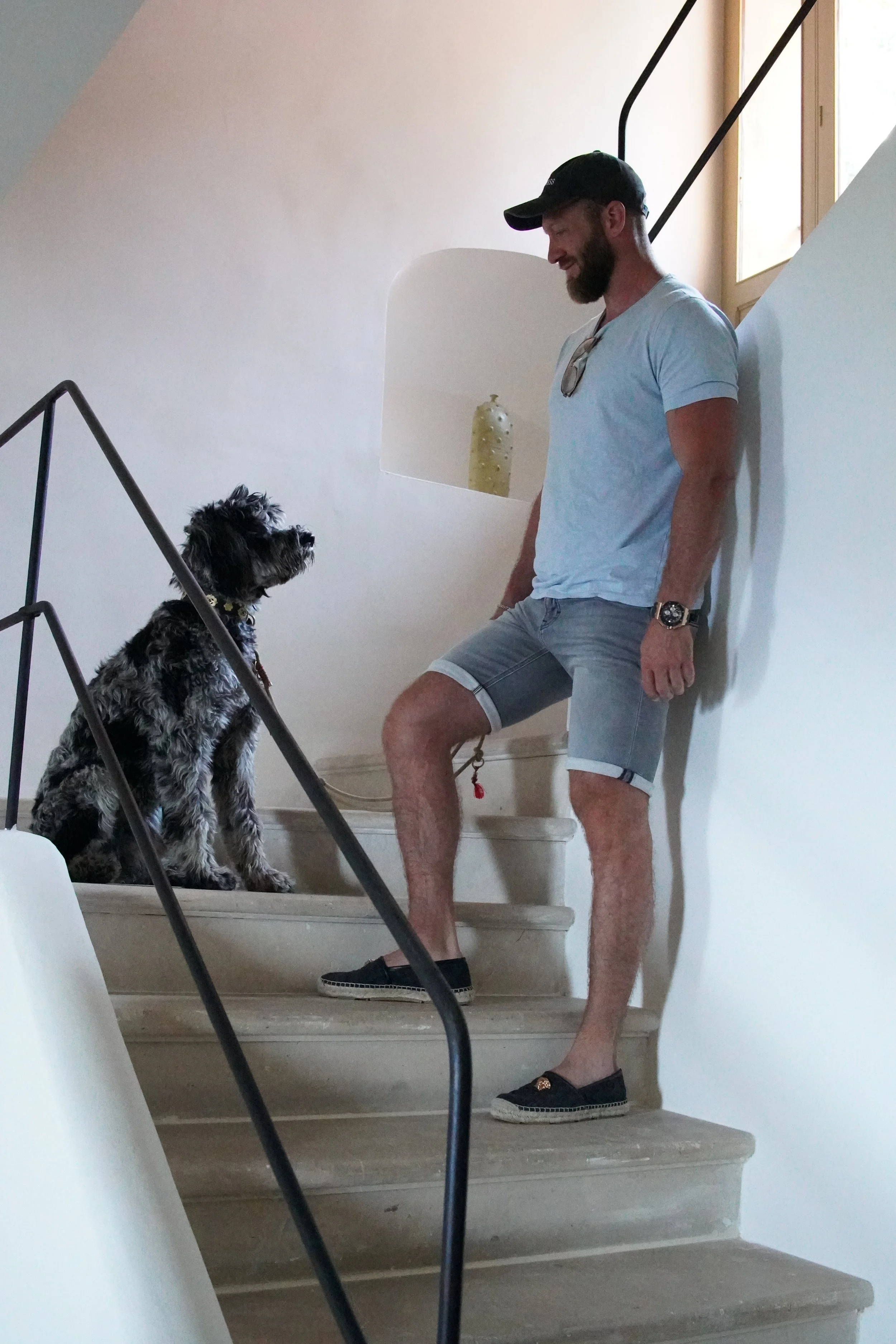
Many people look for set rules. But when training a dog, there aren't just rigid rules—there are different stages, personalities, and situations.
Parenting always happens in phases
Dog training is a developmental process.
What’s still necessary today may become completely second nature in a few months.
That’s why the answer to many questions isn’t simply yes or no, but rather: “It depends on where you are right now.”
If you’re in the early stages and your dog doesn’t yet have a clear sense of direction, then certain structures are crucial.
Example: Little Rambo on a leash
If you have a sassy, cocky, or disrespectful dog that pulls on the leash, pushes, or constantly tries to get ahead of you, then you should make a point of walking out the door first.
Not because you have to be “the pack leader” or because you always “get to go first”—but because doing so conveys order and structure.
This small action shows your dog: “I expect you to behave with decorum and respect. I’m in charge.”
This automatically reinforces basic respect and helps your dog better understand its place in the hierarchy.
Can my dog get on the sofa?
The same rule applies here: It depends on the phase.
If your dog is calm, respectful, and cooperative, then there’s no reason why he shouldn’t lie on the sofa or cuddle with you in the evening.
But if you’re in a phase where your dog is testing boundaries, being disrespectful, or acting uncooperative, then the sofa isn’t an appropriate place.
Because in this phase, the sofa wouldn’t be a place of closeness—but rather a place of confusion.
The dog would see it as a sign that he can do whatever he wants.
And that’s exactly what undermines your leadership role.
A comparison that makes it clear
Imagine you walk into a classroom where there’s total chaos.
The students are goofing off, and the cheekiest one of them is sitting in the teacher’s chair—with his feet up on the desk.
What would you think?
Exactly: that this class completely lacks order and structure.
It’s exactly the same with your dog.
If a restless, cheeky, or overconfident dog is lying on the sofa or is the first to push through the door, the hierarchy isn’t right—not in terms of power, but in terms of clarity.
Heart and Mind
Dog training requires both heart and mind.
Of course, you can allow closeness, build trust, and enjoy cuddle time—but at the right time.
If your dog is in a stable phase, you can let him go through the door first, sit with him on the sofa, or take a more relaxed approach to everyday life.
But if you’re in the initial phase, where you’re working on respect, structure, and guidance, then leadership is still needed—not freedom.
Conclusion
Dog training is not a set of rigid rules, but a process that evolves.
The first phase is about structure and guidance.
The second phase is about trust and balance.
And the third phase is about true freedom—freedom built on clarity.
So:
Don't just use your heart—use your mind, too.
Your dog needs both—your love and your guidance.
Do you want to learn how to tell what stage you're currently in with your dog and what level of freedom he's actually ready for? Then start here with your free initial consultation.