Why Training Partners and Training Groups Are a Real Catalyst
There is something that goes far beyond individual training sessions. Something that often makes the crucial difference between a little practice and real growth.
It’s the people you journey with.
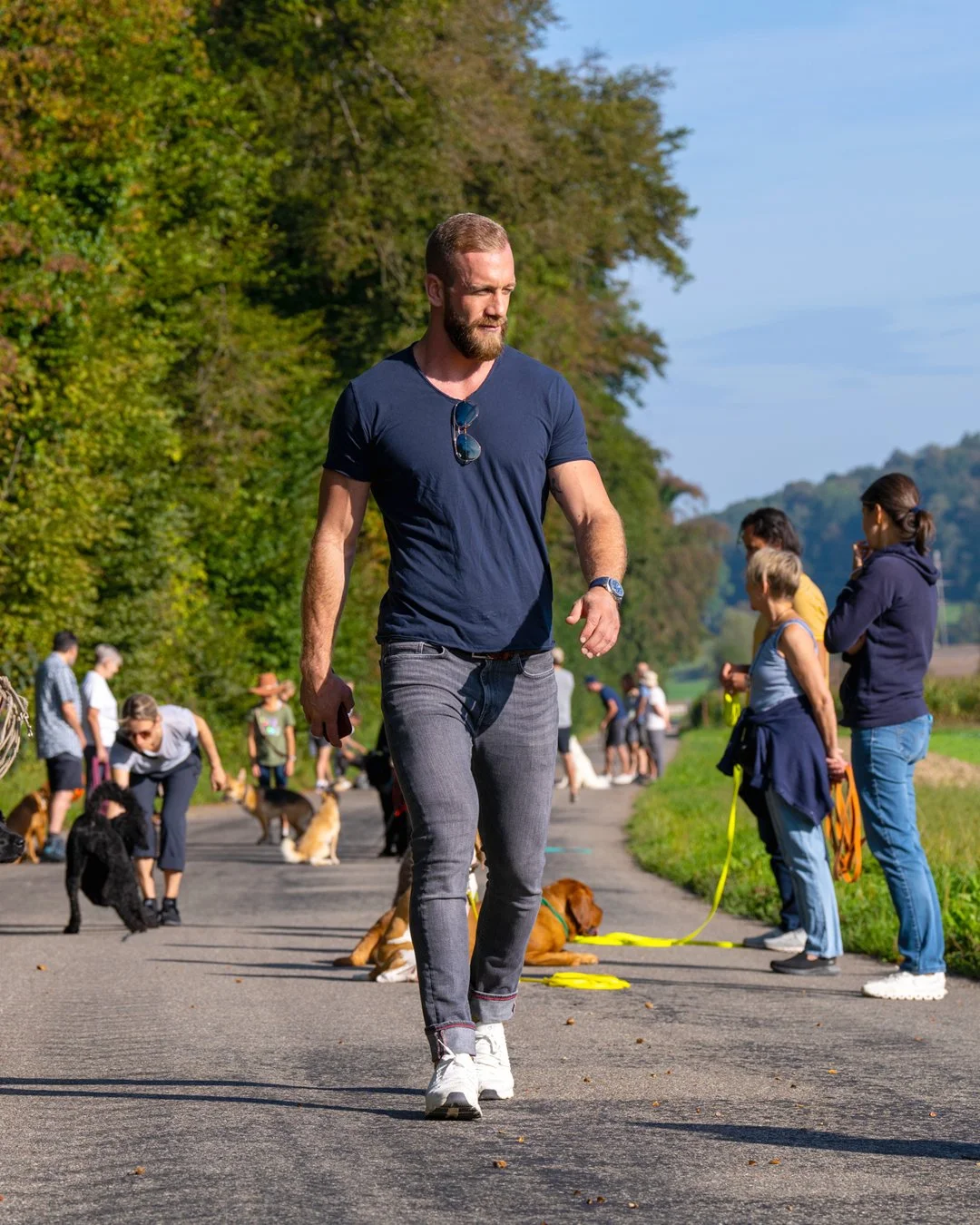
To date, over 6,000 human-dog teams have completed the training program at Marc Welti Dog Training: “The Dog Without a Leash.” Over time, this has given rise to something very valuable:
—a strong community.
A community of people who don’t just want to solve a problem with their dog, but who truly want to grow—with their dog, but also personally.
People who are willing to work on themselves.
People who want to make progress.
People who want to learn.
People who understand that real change comes not only from knowledge, but also from putting it into practice, repetition, and the right environment.
Why the Environment Is So Crucial in Dog Training
Many people underestimate how much their environment influences their own path.
When you’re surrounded by people who have similar goals, who also want to grow, and who are also willing to work on themselves and their dogs, something completely different happens.
Then you’re no longer just training on your own.
That’s when a dynamic develops.
Then a sense of commitment develops.
Then support emerges.
Then motivation arises.
And that’s exactly why my coaching program includes a section dedicated exclusively to finding training partners.
Because I know how powerful it can be when the right people find each other.
Training partners often become true companions
This community has already fostered a great many valuable connections.
Friendships.
Training partnerships.
Small groups.
Larger groups.
People who meet regularly, train together, share ideas, support one another, and work on their goals together.
That’s not just nice.
It’s incredibly valuable.
After all, much progress happens not only during official training sessions, but also in between.
Through repetition.
Through application.
By sticking with it.
Through practicing together.
By taking an honest look.
And this is exactly where training partners and training groups can be a real catalyst.
Why Training Groups Are So Effective
In these groups, people benefit from one another in very different ways.
Some participants already have a lot of experience.
And there are participants who are still just getting started.
Both sides can learn an incredible amount from one another.
The experienced members can provide stability, guidance, and security.
The newer members often bring openness, a willingness to learn, and fresh perspectives.
It’s not about who’s better.
It’s about moving in the right direction together.
The goal of such groups isn’t perfection.
The goal is support.
Courage.
Perseverance.
Shared growth.
And also the reminder that this path isn’t always easy, but it’s worth it.
True progress requires people who are all pulling in the same direction
That is exactly the key point.
These training groups work best when the people in them are truly pulling in the same direction.
When they share the common goal of making the most of the training.
When they don’t just want to be there, but truly want to make progress.
When they don’t just do their own thing while reaping the benefits of a strong group.
Because a good training group thrives not just on attendance.
It thrives on attitude.
On clarity.
From honesty.
From a willingness to embrace a shared understanding of training.
Of course, it can happen that someone in a group does things very differently from what is taught in training.
That is fundamentally their decision.
Everyone is free to choose their own path.
But then you also have to make it clear: Different approaches yield different results.
And often, sooner or later, such a person realizes on their own that they don’t really fit into a group that consciously trains according to a clear concept if they aren’t willing to embrace that concept at all.
This isn’t meant to be mean.
It’s simply logical.
A specific incident illustrates what really matters
Recently, there was an incident in a training group that highlighted exactly this point.
One person kept praising her dog the entire time, even though that didn’t align with the training concept in that situation and was actually counterproductive there.
Another group participant calmly pointed out to her that this behavior wasn’t in line with what is taught in the training.
So, essentially, something that’s exactly in the spirit of a good training group.
Don’t attack.
Don’t judge.
Instead, be attentive and help each other stay on track.
But the person in question was unable to accept this feedback that day. She became very angry and then left.
Things like that can happen, too.
Because wherever people come together, egos, emotions, insecurities, and personal patterns come along with them.
This is not surprising, especially in dog training.
Because dog training is never just about technique.
It also touches on self-image.
It touches on pride.
It touches on shame.
It touches on the question of whether one is open to correction or whether one immediately feels attacked.
Why moments like these reveal so much about development
Situations like these are uncomfortable.
But they’re also revealing.
Because they show who really wants to grow and who, above all, just wants to be right.
Who really wants to train and who only sticks with it as long as everything remains comfortable.
Who is willing to consider feedback, and who immediately resists when corrected.
This isn’t just true in training groups.
It’s true in life.
Growth requires the ability not to take everything personally.
Growth requires the ability to accept correction without immediately crumbling inwardly or lashing out.
Growth requires the ability to realize: Maybe that was just uncomfortable. But maybe it’s still valuable.
Of course, not every piece of feedback has to be perfectly worded.
Of course, everyone is still human.
But if the shared goal is genuine development, then there must be a certain openness to correction. Otherwise, it becomes difficult.
A strong team supports the concept
What I want to make very clear here:
I think it’s great when people in the training groups have the courage to point out, in a friendly and clear way, when something obviously doesn’t fit the concept.
Not out of a desire to be right.
Not out of a desire to act like a know-it-all.
But out of a sense of responsibility for the group’s shared direction.
Because a group only stays strong if it protects its quality.
If it doesn’t start to become arbitrary.
If not everyone simply does everything and at the same time expects the group to retain the same strength regardless.
A good group can be friendly.
But it can also be firm.
It can be open.
But it can also have boundaries.
Because that is precisely what keeps it valuable for everyone who is serious about it.
For those who really want to step on the gas
And this is exactly where I want to deliberately empower my clients.
Those who truly stick to the training.
Those who don’t just consume information, but put it into practice.
Those who accept feedback.
Those who reflect on their progress.
Those who stick with it even when it’s not comfortable.
Those who really want to go all out.
You are a huge part of why this community is so valuable.
You are the reason why individual clients turn into real training groups.
You are the reason why progress continues between official training sessions.
You are the reason others find the courage to keep going.
Why others see that their effort pays off.
Why others realize they’re not alone in facing their challenges.
And that’s exactly why it’s so important that you stick with it.
That you connect with one another.
That you train together.
That you uphold the concept.
That you empower one another.
This community knows what it wants
What has emerged here is not just some random gathering of people with dogs.
It’s a community with a clear direction.
A community that knows what it wants.
People who have realized that freedom with a dog doesn’t just happen on its own.
People who have realized that growth requires effort.
People who have realized that clarity, structure, and action are crucial.
And people who are willing to support one another along the way.
That’s exactly what makes me proud.
It makes me proud to see how small groups form.
How people come together.
How they train together.
How they motivate each other.
How they go all out.
How they don’t give up.
And I can see very clearly how much of an impact this has on their progress when I see these people again later in the official training sessions.
Why Training Groups Accelerate Progress
When people train together regularly, something crucial happens:
What they’ve learned doesn’t remain just theory.
It comes to life.
It becomes part of everyday life.
It becomes a habit.
It becomes stability.
That’s exactly what creates momentum.
Not because everything suddenly becomes easy.
But because repetition, community, and commitment come together.
A person on their own is more likely to let things slide.
A good training group keeps you on track.
Reminds you.
Motivates you.
Reflects back to you.
Corrects you.
Strengthens you.
And that is often the difference between sporadic progress and real development.
Conclusion
Training partners and training groups are far more than just a nice addition.
For many human-dog teams, they are a real catalyst.
Because they create connections.
Because they create motivation.
Because they create repetition.
Because they create support.
And because they create an environment where people can grow together.
Of course, there can be friction in such groups from time to time.
Of course, not everyone can accept every piece of feedback.
Of course, this is also where it becomes clear who is truly open to growth and who isn’t.
But that doesn’t change the value of this community in the slightest.
On the contrary.
It only highlights even more clearly how important it is to move in the same direction.
I’m very proud of all the small and large Marc Welti training groups that have formed.
Proud of the people who come together.
Proud of those who stick with it.
Proud of those who support one another.
And proud of those who really want to go all out.
Because it’s exactly these kinds of people who don’t just make progress possible.
They make it contagious.
If you’d like to be part of a community that doesn’t just talk but takes action—one that empowers each other and wants to continue growing together with their dogs and personally—then schedule your free initial consultation here .
There, we'll work together to assess where you and your dog stand and how you can become part of a journey that's not just training, but true growth.