
Why Desensitization Is So Often Overlooked in Dog Training
One of the most underrated topics in dog training is desensitizing dogs to people. This is something that is discussed far too little. Yet it is incredibly important in practice.
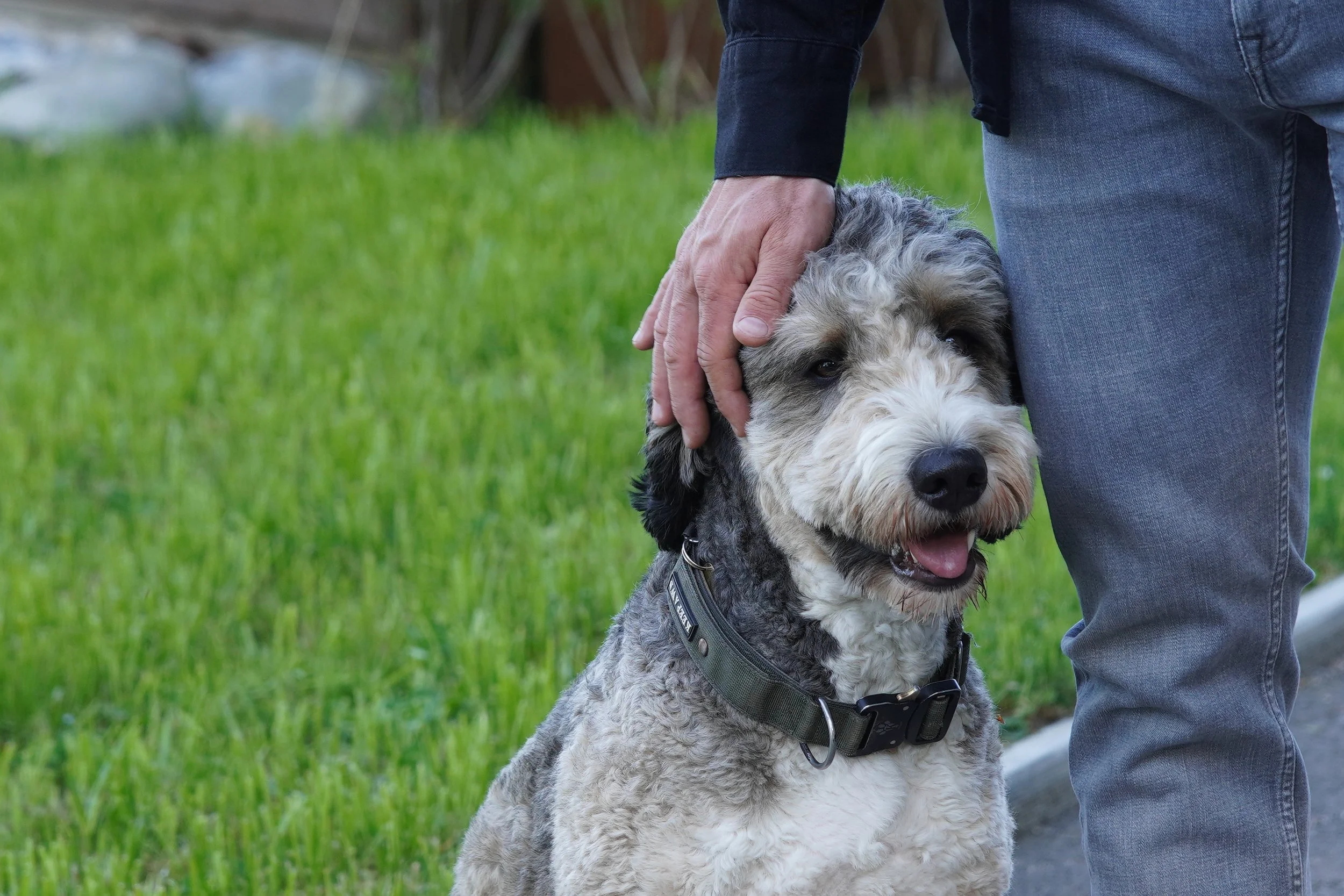
Many people automatically assume that a dog is completely accustomed to humans—that, by nature, it has no real issues with people.
To put it simply: People assume that the dog is fully domesticated and that, therefore, humans are fundamentally normal, harmless, and a given to it.
But that is by no means always the case.
In my coaching work, I frequently encounter dogs that are used to their own owners but not to people in general.
That's a huge difference.
Just because a dog gets along well with its family doesn't necessarily mean that it feels truly at ease around strangers.
Many dogs are only truly accustomed to their primary caregivers
In practice, you can see this very quickly.
A dog can seem completely unremarkable at home with its owners. It’s relaxed, affectionate, well-suited to everyday life, and trusting.
But as soon as a stranger enters the picture, everything changes.
Suddenly, uncertainty sets in.
Or aloofness.
Or defensiveness.
Or avoidance.
Sometimes very obvious, sometimes more subtle.
This is exactly where it becomes clear that the dog is not, in general, neutral and stable toward people, but only toward its familiar surroundings.
You can often tell by very simple situations
Imagine a stranger approaching your dog.
Maybe the person is tall.
Maybe they’re wearing dark clothes.
Maybe a hat.
Maybe they have a beard.
Maybe they’re walking straight toward the dog, talking to it, or even trying to pet it.
What happens then?
Does your dog remain calm and neutral?
Can he handle the situation without getting stressed?
Or does he back away?
Does he become unsure?
Does he avoid the situation?
Does he bark?
Does he growl?
Or does he even move forward?
It's moments like these that clearly show how your dog really perceives people.
It often matters whether the situation is taking place outdoors or indoors—whether your dog has room to get out of the way or not, and whether he’s on his own territory or on neutral ground. But regardless of these factors, the key question remains the same:
Can your dog generally tolerate human contact without becoming stressed, anxious, or defensive?
Why this is so important in everyday life
This topic isn’t just a minor detail.
It’s relevant to everyday life.
Because if a dog has the underlying assumption that strangers are potentially dangerous, that can lead to situations that range from frustrating to dangerous.
Not just for you.
Not just for the dog.
But also for others.
Because you can’t control everything in life. It can always happen that people get close to your dog, talk to him, or maybe even touch him without asking.
That’s not ideal. But it’s a reality.
And that’s exactly why it’s important for your dog to be able to handle it.
He doesn’t have to love it. He doesn’t have to think strangers are great. And I wouldn’t recommend that everyone touch your dog, either.
But if it does happen, it shouldn’t become a serious problem for your dog.
Tolerance is the goal here. Not enthusiasm.
At this point, discipline alone is often not enough
This is exactly where many people make a mistake in their thinking.
They believe the problem can be solved purely through training.
Of course, training is important.
Of course, clear rules, structure, and well-defined agreements are necessary.
But when a dog has a real issue with people, training alone is often not enough.
I see this time and time again.
Clients make great progress with their dogs.
For example, the dog learns to go to its spot or into its dog bed when visitors come over.
It also stays there.
So it sticks to the agreement.
This is generally very good and already brings a certain amount of calm to the situation.
But even so, the actual problem hasn’t been solved.
Because although the dog is lying in bed, he’s barking loudly.
Or growling.
Or he’s extremely tense on the inside.
Or he’d really rather run away.
This means: The behavior is more outwardly controlled, but the emotional reaction toward the person is still there. And this is exactly where you need to take it next.
If the dog is still on high alert internally, the issue hasn't been resolved
This is a very important point. Just because a dog is no longer actively doing something doesn’t mean it’s internally relaxed.
A dog can go through the motions and still be stressed out on the inside.
A dog can stay in its spot and still be completely overwhelmed.
A dog can stand still and still perceive people as threatening.
That’s why you shouldn’t be satisfied too soon.
Training creates order.
Desensitization changes the emotional assessment.
And it’s precisely this emotional level that’s the real sticking point for many dogs.
That's why desensitization is so important
A dog that has problems with people should be desensitized to people as much as possible.
That doesn’t mean you have to turn every dog into one that loves every person.
That’s not the point.
Nor is it about letting just anyone pet your dog.
And it’s not about simply ignoring your dog’s boundaries.
It’s about your dog learning to perceive people in a more realistic, neutral, and less threatening way.
That he can tolerate closeness better.
That he doesn’t immediately default to anxiety, flight, or aggression.
That his nervous system doesn’t go on high alert every time he encounters an unfamiliar person.
That’s exactly what’s extremely valuable in everyday life.
Otherwise, many situations will remain unnecessarily stressful
If this issue isn't addressed, many situations will remain permanently tense.
Visits at home.
People in the office.
Walks where people come close to one another.
Close encounters.
Unexpected physical contact.
New environments.
All of this can then become a recurring problem.
The dog remains suspicious.
The person remains tense.
And often, people then just try to control situations somehow, instead of truly addressing the root cause. But in the long run, that’s not a real solution.
Not every dog has to like people. But it should be able to tolerate them.
This is important to me.
I’m not saying that every dog has to like it when strangers touch him.
In fact, I’d even be careful to make sure that people aren’t constantly approaching your dog without asking.
But there’s a big difference between not liking something and not being able to tolerate it.
A well-adjusted dog is allowed to be aloof.
He’s allowed to be reserved.
He doesn’t have to find everyone likable.
But he should be able to tolerate the fact that people exist, approach him, and—in certain situations—even enter his personal space without it immediately becoming a serious issue.
That’s exactly what makes him suitable for everyday life.
Conclusion
Desensitization to people is one of the most underestimated topics in dog training.
Many dogs are not as naturally accustomed to strangers as is often assumed. They know their family, but they don’t automatically view people in general as something truly neutral and harmless.
That is exactly why training alone is often not enough.
After all, a dog can learn to stay reliably in bed while visitors are over and still bark, growl, want to run away, or be under immense stress.
If your dog reacts to certain people with anxiety, aggression, or a desire to flee, then you should take this issue seriously.
Not out of fear.
But out of a sense of responsibility. '
Because the sooner you address this issue thoroughly, the more peace, security, and adaptability to everyday life can result.
If you’d like to learn how to not only guide your dog externally but also help him internally to perceive people in a more relaxed and neutral way, then schedule your free initial consultation here .
Together, we’ll examine how your dog reacts to people, where the actual problem lies, and what it takes to foster true calm and stability.